
Andrews County Criminal Court Cases
Andrews County criminal court cases do not sit behind one counter. The 109th Judicial District Court and District Clerk handle felony cases. The courtroom is at 201 N. Main St., Room 201, and the clerk is in Room 102. The court phone is 432-524-1419, and the district clerk can be reached at 432-524-1417. The state directory confirms that the clerk uses Odyssey for criminal filings. Filed pleadings, docket activity, judgments, and sentences in an Andrews felony prosecution therefore trace to the District Clerk, not to the sheriff's booking file.
The constitutional County Court handles misdemeanor criminal cases. Its custodian is the Andrews County Clerk at 215 NW 1st St., Suite 121-A, Andrews, TX 79714, 432-524-1426. Fine-only city offenses remain with the City of Andrews Municipal Court, while justice courts retain Class C and other matters within their jurisdiction. The clerk split matters because asking the wrong office can produce a valid but incomplete answer.
The county clerk's official page shows the misdemeanor office readers need to identify. The image below comes from that Andrews County Clerk source.

That office page confirms both the local misdemeanor role and the counter used to request Andrews County case records.
Choose the Andrews Case Clerk
Start with the filed charge, not merely the booking label. A felony-level filing goes to the District Clerk. A misdemeanor filed in the constitutional County Court goes to the County Clerk. A city citation or fine-only state offense may remain at Municipal Court, and a justice-court matter stays with its precinct. Arrest charges can be reduced, enhanced, replaced, or declined before filing, so the booking description may point to the wrong court.
District Clerk
201 N. Main St., Room 102
Andrews, TX 79714
432-524-1417
Felony filings in the 109th Judicial District Court.
County Clerk
215 NW 1st St., Suite 121-A
Andrews, TX 79714
432-524-1426
Misdemeanor criminal cases. Counter hours are Monday through Friday, 8 a.m. to 4 p.m.
When only an arrest date is known, call the likely clerk with the full name, date of birth, and approximate year. If neither clerk finds a filing, ask the arresting agency whether prosecutors filed a cause number yet. A recent booking may exist before any criminal court case opens.
Searching Andrews County Case Records
re:SearchTX is the statewide electronic court platform, but Andrews County coverage depends on what the contributing clerk makes public. Use it as a locator, then verify the Andrews criminal case with the originating clerk. A cause number is the strongest key. A name search works better when paired with the filing year, date of birth, county filter, and case type.
- Decide whether the filed charge belongs in district, county, municipal, or justice court.
- Search re:SearchTX by cause number or party name and set Andrews as the location.
- Narrow broad results by case type and date range, then compare identifying details.
- Read the docket events, status, charge, and judgment fields without assuming every document is online.
- Contact the correct Andrews clerk for confirmation, copies, or a certified judgment.
| Field Label | Type | Required | Notes |
|---|---|---|---|
| Person or business | Text | One criterion | Name spelling affects matches |
| Case or cause number | Text | Alternative | Strongest exact identifier |
| Location or county | Filter | No | Select Andrews |
| Case type | Filter | No | Public options depend on the contributor |
| Date range | Date filter | No | Narrows filings and events |
| Search | Button | Yes | Runs the query |
The platform's own interface illustrates why a state result is a starting point. This image is linked to the official re:SearchTX source.
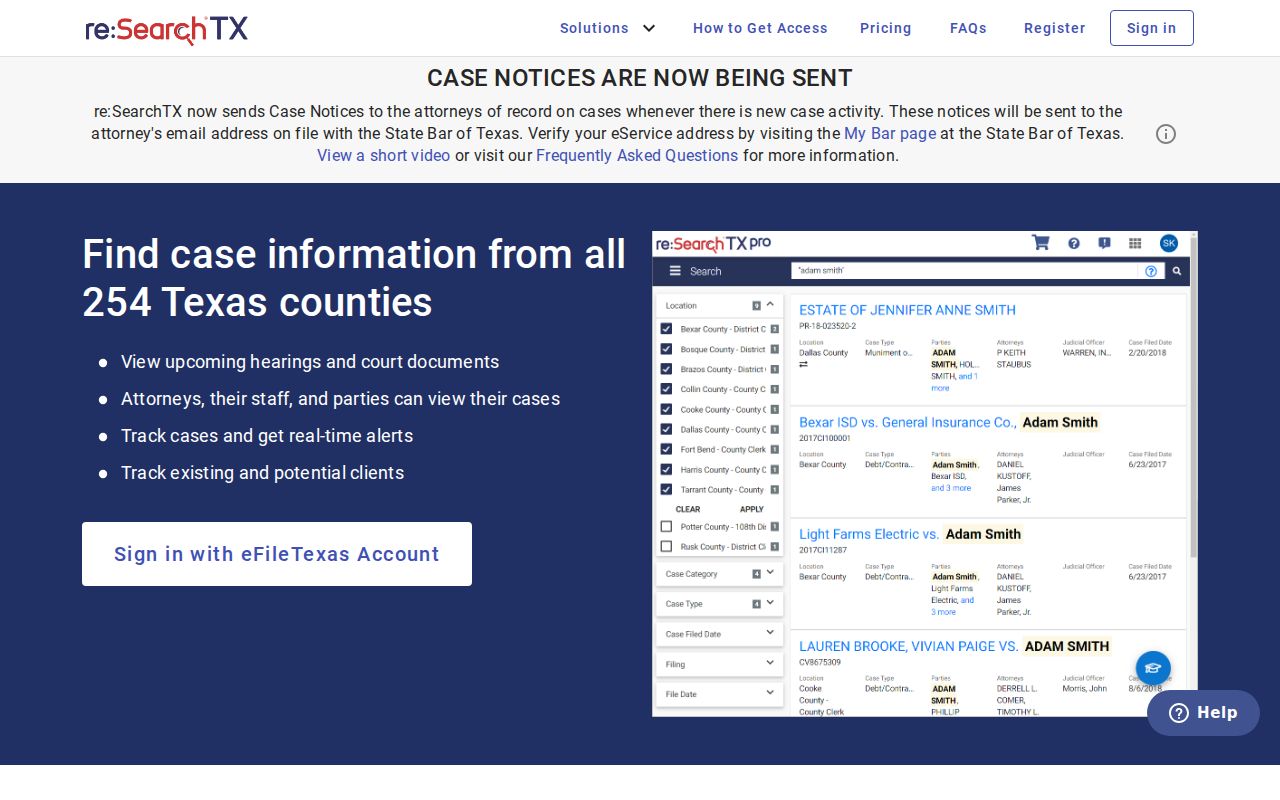
Search tools can expose a docket while leaving some Andrews pleadings behind a login, a fee, a redaction, or the clerk's counter.
Contact the Andrews Clerk First
The County Clerk has an unusually specific request and payment sequence. Email vscott@co.andrews.tx.us or rmiranda@co.andrews.tx.us, or call 432-524-1426 before 4 p.m. Ask for the request form, cause number, and Certified Payments bureau code. The clerk says a requester who pays before making contact will not receive a refund. Major cards are accepted, payments must be in full, and the processing service adds a nonrefundable service charge.
The official instructions are visible in the county's court-record payment source.

The screenshot reinforces the local rule: obtain the clerk's form and payment details before sending money.
Inside an Andrews County Case File
An Andrews County criminal case file follows the prosecution after charges are filed. It is distinct from the arrest report and jail booking. Where public, an Odyssey or re:SearchTX view may show a cause number, court, filing date, defendant display name, the State of Texas as a party, counsel, charge text and degree, bond data, hearing dates, docket events, disposition, and judgment date. Document links may be limited, and sensitive victim, juvenile, and identity data can be removed.
| Case Number and Court | Identifies the cause and the Andrews court that controls it. |
|---|---|
| Charging Document | The complaint, information, or indictment states the count actually filed. |
| Docket Entries | Chronological notices of filings, settings, orders, and case events. |
| Hearing Dates | Scheduled appearances and later changes reflected by the clerk. |
| Disposition and Judgment | Records dismissal, acquittal, conviction, deferred adjudication, or another result. |
| Sentence and Conditions | Shows the court's punishment and public supervision or bond terms when filed. |
For proof of one local outcome, request a certified judgment from the appropriate Andrews clerk. It is stronger than a screenshot of a name-search result. Ask for the docket sheet, charging instrument, judgment, sentence, bond orders, and disposition, then ask which copy fees and redactions apply.
Andrews Criminal Dockets in Archives
Permanent county holdings date to 1881, though not every old item is criminal or open. The Andrews County Archive Center bridges part of the gap between modern electronic access and older files. Its categories include 109th District Court dockets, general dockets, court schedules, fee schedules, and standing felony bond conditions. Search fields include keywords, an archive category, a time period, and start and end dates in month/day/year format.
Do not confuse that archive with the county's Online Official Public Records Search. The latter is described for recorded documents and federal tax lien searches, not as a complete Andrews County criminal docket. If an archive entry identifies the right date or docket, give that detail to the District Clerk when requesting the underlying case file.
The search interface can be seen in the official county archive source.

The archive is most useful as a route to a date, schedule, docket, or bond condition that can sharpen a clerk request.
How a Criminal Case Moves
The filed case begins after an agency encounter and prosecutorial review. A magistrate first addresses probable cause, warnings, and bail after arrest. Prosecutors may then proceed by complaint and information or present a felony to a grand jury for indictment. Arraignment records the plea. Pretrial entries can reflect motions, discovery disputes, settings, and bond orders. A plea or trial leads to a judgment, and sentencing states the court's result. An appeal, when filed, creates further docket activity.
Case flow: Charges Filed › Arraignment › Pretrial › Plea or Trial › Disposition › Sentencing
The order matters because a booking charge is not always the filed count. A later dismissal also does not erase the arrest on its own. For the wider arrest trail that precedes filing, the Andrews County arrest lookup explains agency and jail channels.
Read Andrews Case Outcomes Carefully
A status label should be read in its court context. “Pending” means the case still needs current clerk verification. “Dismissed” means the filed count ended without conviction, but it does not by itself erase an arrest. “Acquitted” follows a not-guilty result. “No-bill” means a grand jury declined to indict the felony presented. “Deferred adjudication” postpones a judgment of guilt under court terms and is not the same as a conviction, though specified Texas deferred information can remain public unless an order of nondisclosure applies.
- Filed charge
- The accusation the prosecutor placed in court, which may differ from the arrest charge.
- Disposition
- The recorded result of a charge, such as dismissal, acquittal, conviction, or deferred adjudication.
- Judgment
- The court's formal written decision, often the best source for the final outcome.
- No-bill
- A grand jury decision not to indict the felony presented to it.
When a DPS name search and an Andrews judgment conflict, compare the cause number and identifiers. A missing or mismatched disposition may require the clerk or reporting agency to correct what it sent to the state repository.
Andrews Criminal Case Age Context
The Texas Judicial Branch district age report lists 212 pending Andrews criminal cases at its reporting point. Of those, 34 percent were 90 days old or less, 24 percent were 91 to 180 days old, 25 percent were 181 to 365 days old, and 17 percent were more than 365 days old. These figures describe pending case-age groups. They are not crime totals, unique defendant counts, or conviction rates.
Age data can explain why an open docket has many entries without a disposition, but it cannot predict a particular case. Settings move, motions take time, and every file has its own procedural record. Read the current Andrews docket and confirm the status with the clerk instead of drawing an outcome from the countywide percentages.
Federal Cases Outside Andrews Courts
A federal prosecution will not appear as an Andrews County criminal court case. Andrews County lies within the U.S. District Court for the Western District of Texas, though a reader should confirm the correct division before visiting. PACER supplies federal docket sheets and filed documents after registration. Its published schedule charges ten cents per page, generally caps one document at three dollars, and waives quarterly fees when total charges are thirty dollars or less.
The Western District's official site identifies the federal court layer. This image links to the Western District of Texas source.
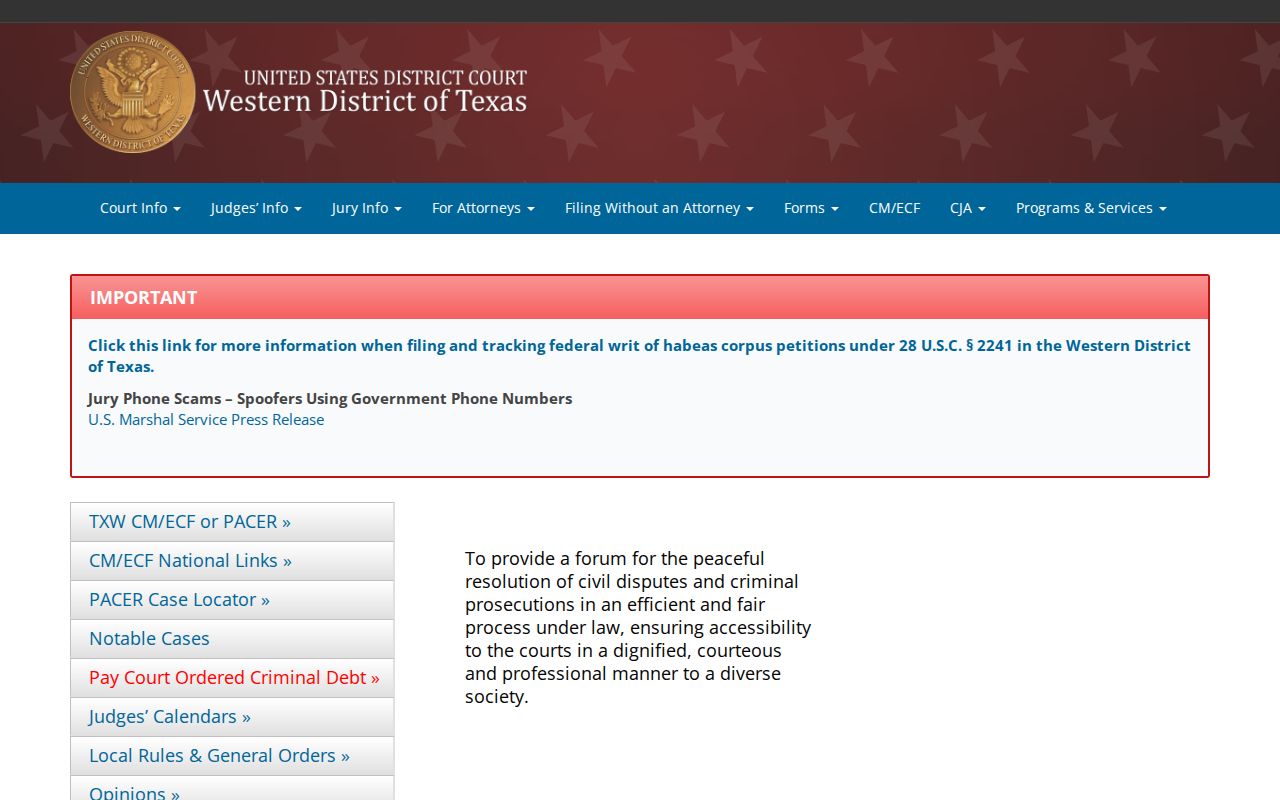
Use that court site to confirm divisions and local procedures rather than assuming the county courthouse keeps a federal file.
PACER is the official electronic docket channel. The following image comes from the PACER source.
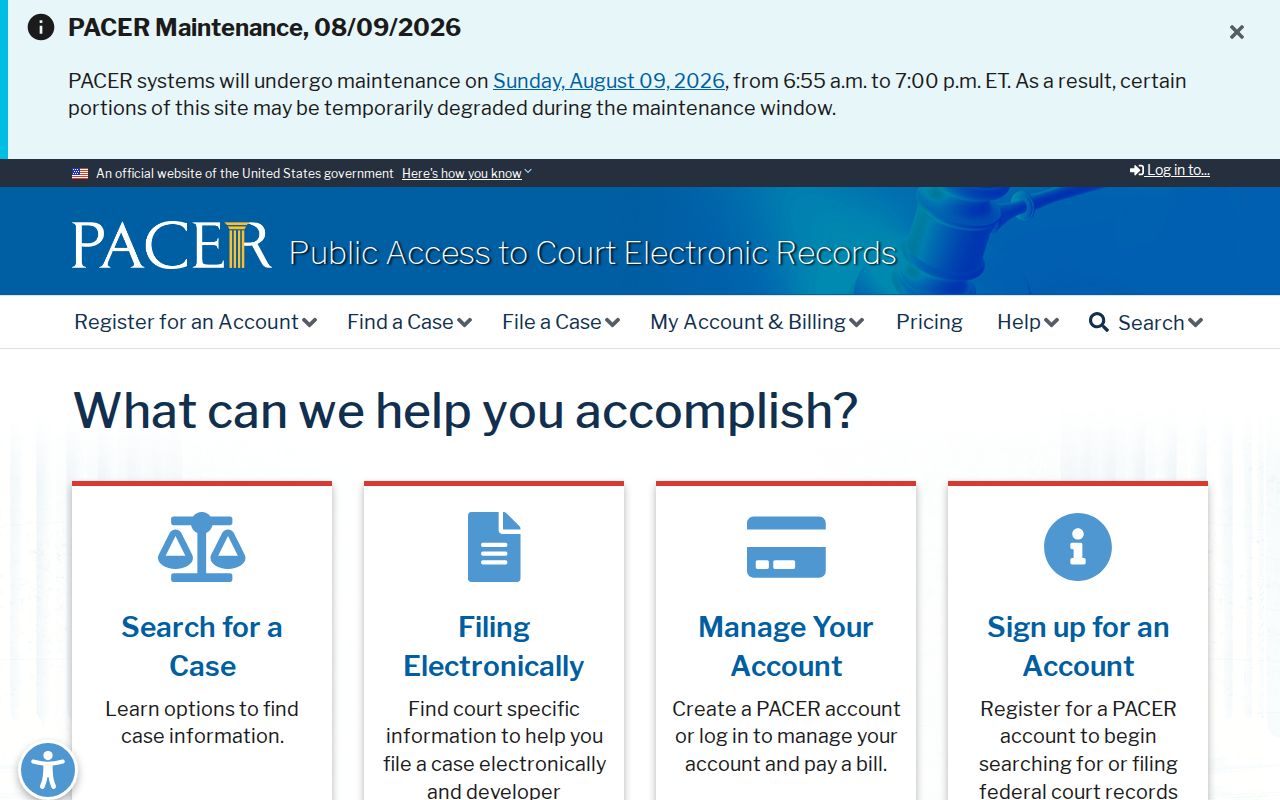
The federal system is separate from Odyssey, re:SearchTX, and both Andrews County clerks.
Case Record Access & Restrictions
Texas court files are generally approached through judicial access rules and the court that holds them, not by treating the clerk like an ordinary executive-agency records office. Ask the Andrews clerk for the case record itself. Use a Texas Public Information Act request for investigative records held by the police or sheriff. The distinction prevents a request for pleadings from being sent to an agency that never held them.
Public views may redact Social Security numbers, driver's-license data, protected victim details, medical information, juvenile material, and other confidential fields. Active prosecutorial or investigative work can also be withheld under applicable law. An expunction under Texas Code of Criminal Procedure Chapter 55A removes qualifying records as the order directs. An order of nondisclosure limits ordinary public release but does not destroy the file or bar all authorized access.
Note: A certified Andrews judgment is the clearest public record of a specific local disposition when search screens or repository entries differ.